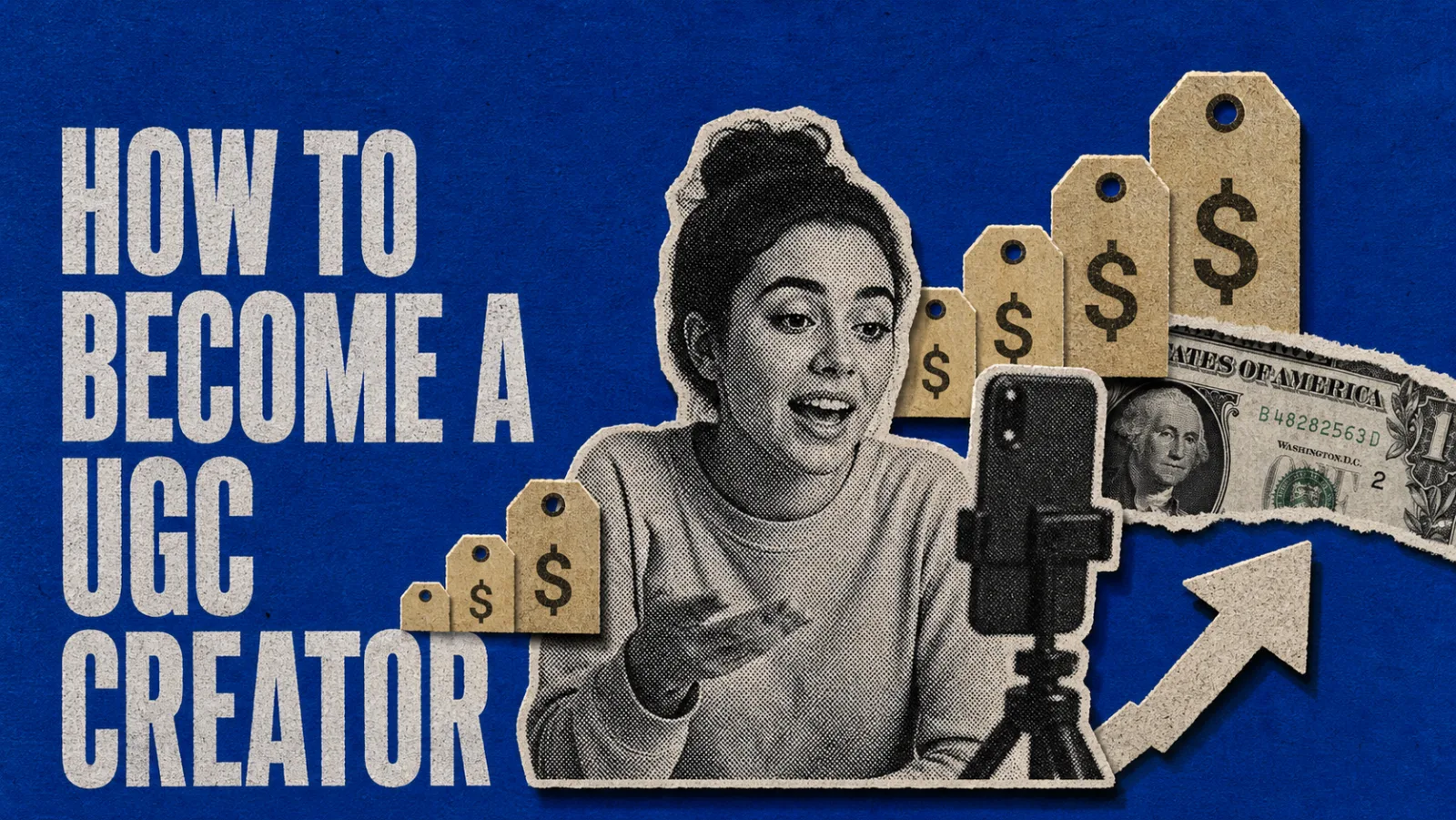
A first-year UGC creator with no following can charge $75 to $150 for a 15-second product video, and brands will pay it. A mid-tier creator with a six-month portfolio and tracked ad performance moves into the $300 to $1,000 range per deliverable. The market average across all tiers, pulled from real platform data, sits at roughly $198 per video in 2026, with the average single UGC video coming in around $212 (Influee, UGC Rates 2026).
Those three numbers are the entire rate ladder, and they’re the part most “how to become a UGC creator” articles skip. The reason brands pay them is structural: UGC content is bought as a deliverable, not as audience access. Follower count doesn’t price it. Output quality, conversion track record, and turnaround time do (JoinBrands, How Much Do UGC Creators Charge). That’s the wedge if you’re starting from zero followers in May 2026. This guide walks the ladder one rung at a time: what a UGC creator actually is, what the rate tiers look like, which brands hire at each tier, why most pitches get rejected, the production workflow brands quietly expect, and the legal setup that keeps the income clean.
What a UGC creator actually is (and what you’re not signing up for)
A UGC creator produces short-form video content that brands run as paid ads, on product pages, in email sequences, or organically on the brand’s own social accounts. The brand owns the content on delivery. The creator typically does not post it to their own audience (Influee, UGC vs Influencers).
That second sentence is the line that separates UGC from influencer work. An influencer sells you reach: an audience of 50,000 people will see this on my feed, here’s the rate. A UGC creator sells you a video: this 30-second clip is yours to run wherever you want, the rate is for the deliverable, you negotiate usage rights on top.
The structural implications are big. You don’t need a following. You don’t need to grow one. You don’t need to maintain a posting schedule on your own channels. What you do need is the ability to read a brief, shoot at iPhone-and-ring-light quality, deliver fast, and produce content that performs when the brand runs it as a paid ad. A winning UGC creator needs hands-on UGC experience and the ability to sell naturally, without sounding like an ad (Hustler Marketing, How to Source UGC Creators 2026).
The other practical wedge: rates are deliverable-based, but usage rights stack on top. Industry pricing for usage rights typically runs 20 to 150 percent of the base rate depending on duration and channel scope. A six-month organic license is cheap. Perpetual paid-ad rights cost real money on top of the base (Influee, UGC Usage Rights). New creators routinely forget to price this, then watch a $150 video run as a $30,000 Meta ad campaign for a year. Don’t.
The 2026 rate ladder
Here’s what the market actually pays, pulled from platform data and recent rate-card surveys. Treat it as a working ladder, not a salary table.
| Tier | Typical per-video rate | Typical brand category |
|---|---|---|
| Just starting (no portfolio, <6 months) | $75–$150 for 15s; $100–$200 for 30s; $150–$300 for 60s | Small DTC brands on Billo, Insense, Collabstr; first-time CPG launches; app installs |
| Established mid-tier (6–18 months, 20+ shipped deliverables) | $300–$1,000 per video | Mid-market DTC beauty, supplements, fitness apps, mid-size CPG |
| Top-tier (proven ad performance, repeat client list) | $600–$3,000+ per video | Sephora-tier beauty, large supplements, household-name DTC, agency-managed campaigns |
The data: beginners typically charge $75 to $150 for 15-second video, $100 to $200 for 30 seconds, $150 to $300 for 60 seconds, with photo sets of 5 to 10 images at $50 to $150 (UGCRoster, Beginner UGC Creator Pricing). Mid-tier sits in the $300 to $1,000 band as creators build case studies, and top-tier runs $600 to $3,000+ per video for established names (UGCJobs, How Much Do UGC Creators Make in 2026).
The retainer ladder is a separate income stream most beginners ignore. Once you’ve shipped 15 or 20 videos, the offer shifts from per-deliverable to monthly. Retainers contribute $1,000 to $2,500 per month in predictable income from a single client. Two or three retainers at $1,500 each get a full-time creator to $4,500 to $7,500 monthly without chasing one-off briefs (UGCJobs, How Much Do UGC Creators Make in 2026). Package pricing, typically 4 to 8 videos a month, runs a 15 to 20 percent discount versus individual rates in exchange for predictable revenue on both sides.
Two practical notes on the ladder. First, the market average per deliverable in 2026 sat at around $198, slightly below 2025 levels because creator supply grew and synthetic-UGC tooling pressed the floor (Influee, UGC Rates 2026). That’s not a reason to undercharge. It’s a reason to skip the bottom 20 percent of the market and target serious brand briefs. Second, brands routinely add 30 to 50 percent on top of base rates for paid-ad usage rights specifically. Quote both lines on every invoice. Don’t bundle them silently.

Which brands actually hire (and where to find the briefs)
The brand list is where most career guides go vague. Here’s what’s real in 2026.
Beauty and skincare is the densest hiring category. Sephora runs the Sephora Squad as an active UGC pipeline, recruiting creators for tutorials, GRWM videos, and product comparisons. Glossier features real users in everyday-routine content. ColourPop runs ongoing creator pipelines for makeup demonstrations (CreatorsKit, 100 Brands Looking for UGC Creators 2026).
Fitness and wellness is the other density zone. Bloom Nutrition scaled almost entirely through aggressive UGC and influencer marketing and remains one of the most accessible briefs for fitness-niche creators (CreatorsKit, 100 Brands Looking for UGC Creators 2026). Apps in the fitness, meditation, and habit-tracking space hire continuously: the unit economics on a $9.99 monthly app justify $200 to $500 per video at volume.
The brand-discovery surface is platform-mediated for almost every new creator. Insense connects 2,000+ DTC brands, Amazon sellers, apps, and agencies with vetted creators and is the most consistent first-deal source. Collabstr connects creators to 130,000+ brands across fashion, beauty, lifestyle, fitness, and comedy, including names like McDonald’s, Wealthsimple, Deezer, and Hopper (CreatorsKit, 100 Brands Looking for UGC Creators 2026). Billo, JoinBrands, and Influee round out the major hiring marketplaces.
Direct outreach to brands you actually use works for niche creators willing to write 50 targeted emails a week. The conversion rate is low, but the pay is higher because there’s no platform skim. The fastest first-deal path remains the marketplaces; the higher long-term ceiling sits with direct relationships.
Why most new UGC creators get rejected
This is the part the guides smooth over. Brands reject pitches and submissions for a small set of repeating reasons, and they’re all fixable.
The biggest single rejection driver is creator-brand mismatch. If the creator doesn’t understand the brand’s voice, the deliverable lands generic, forced, or misleading. The fix is reading three of the brand’s existing ads on Facebook Ad Library before pitching, and tailoring the spec video to that voice. Vague submissions also get rejected at scale: structured briefs improve first-submission approval rates by 40 percent and reduce revision requests by 60 percent per 2026 Influencer Marketing Hub research (InfluenceFlow, UGC Creator Brief Template 2026).
The second-most common rejection is over-scripted delivery that reads as a disguised ad. Brands buy UGC specifically because it doesn’t sound like an ad. A creator who hits every brand bullet point in a wooden monologue gets rejected in favor of someone who improvises 80 percent of the script and lands the product mention in passing. The skill is acting natural while still hitting the conversion beats (Hustler Marketing, Top 5 UGC Marketing Mistakes).
Production quality is the third filter, and it’s the one new creators most overestimate as expensive to fix. The bar isn’t broadcast TV. The bar is: stable handheld or tripod, natural light or a ring light, clear audio with no room echo, vertical 9:16 framing for paid social, and clean cuts. A smartphone with a decent camera, a $30 to $50 ring light, and a clean background is enough to produce professional-quality UGC (Influee, How to Become a UGC Creator). What gets rejected isn’t lack of gear. It’s wind noise in the audio, soft focus on the product label, and 16:9 footage when the brief asked for vertical.
The last filter is turnaround speed. Brands working with new creators are running a small bet: can this person deliver in 5 days, and respond to revision notes inside 24 hours? Hit those two windows for your first three deals and the repeat-client offers start arriving.

The workflow brands quietly expect (where editing fits)
The pitch-to-delivery loop has four steps, and the editing layer is where most new creators bottleneck.
Step one is the brief read. Pull the brand’s existing ads from Facebook Ad Library, note the voice, note the hook patterns, note what the brand has not tried recently. Your pitch should reference one specific ad you’d improve on.
Step two is the shoot. The honest production guidance: shoot longer than the deliverable. A 30-second brief gets a 4-to-6-minute source recording, three variations of the hook, two product-shot angles, and a quiet 30 seconds of room tone. Brands love variant deliverables, and the cost of recording more during a single setup is zero.
Step three is the cut, and this is where the rate ladder actually splits. A beginner cuts a single 30-second deliverable from the 4-minute source. A mid-tier creator cuts three: a 30-second main, a 15-second variant with a different hook, and a 60-second long-form for organic. The brand sees three usable assets from one shoot, and the per-shoot economics work out dramatically better.
A transcript can help you find a spoken line before checking its delivery in the video. Mark the strongest takes, build the requested versions, then watch each cut for pacing, product visibility, caption accuracy, and the agreed brief. The number of usable versions depends on the source material and the review work.

ChatCut can turn a source recording into versions with different openings and lengths. Use text-based editing to work from the transcript, then refine the result on the multi-track timeline. Add AI captions and check their wording, line breaks, timing, and placement against the brand’s brief.
For a shot you have not filmed, use AI video generation with the inputs supported by the selected model. Manual Video Gen requires Pro and credits; review the current estimate before sending. Finished manual generations appear in My Assets, ready to drag onto the timeline. ChatCut also supports official and personal AI avatars for presenter videos. Choose recorded footage, generated scenes, or an avatar according to the creative brief and the permissions you have.
The principles vs the bottom lines
Build each version around a clear opening, an accurate product claim, and the requested call to action. Review the actual video before delivery; a prompt or a transcript selection is the start of an edit.
ChatCut is available on the web and as a native macOS or Windows app. Export options depend on the device and rendering path: Desktop local video export supports 4K, and compatible browsers can also offer 4K. Check Web vs Desktop Export before agreeing to a delivery format.
The Free plan includes the core editor. Check your account for its current starting offer and credit balance, and Upgrade for current paid options. Starting allowances change during product tests, so plan the job around the offer actually shown in your account.
For the broader social workflow this slots into, social media content production walks the multi-platform side; for the long-source-to-cuts pattern specifically, turn long videos into shorts covers the editing logic in more depth. Talking-head creators recording themselves do the same long-source workflow, and talking-head editing is the natural extension. For creators who started on YouTube before moving to brand work, best AI video editor for YouTube covers the editing-stack decisions that carry over.
The legal and tax setup (the part that’s actually boring)
For US creators, the IRS Self-employed Individuals Tax Center explains filing, estimated payments, and related resources. Keep records of payments and business expenses, and check the current rules for your circumstances.
Business structure involves legal and tax considerations. Use the IRS business-structures guide as a starting point and get advice for your jurisdiction and contracts. A general creator-income tier does not determine which structure or tax reserve is right for you.
Five direct answers before you start
Do I need a following to get my first deal? No. UGC rates are based on deliverables, not follower count. A 3-video portfolio and consistent outreach lands most new creators a first client inside 2 to 4 weeks (Influee, How to Become a UGC Creator).
What’s the realistic first-year income range? Part-time creators shipping 10 to 15 videos a month typically earn $1,500 to $4,000 monthly. Full-time creators with established client relationships and package deals can reach $5,000 to $15,000+ per month (Influee, How to Become a UGC Creator). The realistic first-year median is closer to part-time, because the second-deal-to-fifth-deal pipeline takes time to build.
Should I price usage rights into the base rate or separately? Separately, always. Brands expect a base-deliverable line and a usage-rights line. Bundling silently is how creators end up with $150 videos running as $30,000 ad campaigns. Quote 6-month organic at one rate, 12-month paid-ad rights at a different rate, perpetual at a higher one.
How long until I can quit my day job? Most creators who hit $5,000+ monthly do so 12 to 18 months in, after building a 2-to-3-client retainer base. The first 6 months are portfolio-building at lower rates. The next 6 are conversion to retainers. Skipping the portfolio phase doesn’t accelerate the timeline; it usually extends it.
Is it worth doing this full-time given AI synthetic UGC tools? Assess demand for your work, repeat bookings, costs, and the rights your clients need. ChatCut can edit recorded footage, generate scenes, and create avatar presenter videos. The choice depends on the brief; this guide does not establish a conversion advantage for one production method. A recorded testimonial and a generated presenter should be represented accurately to the client and audience.
Try ChatCut Free to edit your UGC sample and review alternate cuts. Check your account for the current starting offer and balance; video generation requires Pro and credits.